Yerington Monday: What's In A Name?
Yerington has gone by three different names in its history: Pizen Switch, Greenfield and Yerington. Yerington is located in Mason Valley in Lyon County, Nevada Yerington’s history dates way back to the 1850’s.
(Information taken from The Lyon County brochure "What's In A Name")
PIZEN SWITCH
Agricultural communities have a way of becoming established before the town historians are ready to record the event for posterity. By 1881 the story was being retold that N.H.A. "Hock" Mason was driving cattle to California and happened to pass through this valley in 1854. He returned five years later and settled along the Walker River north of the present town. The valley that was named for him was known for its pasturage along the river and ability to produce crops of barley, potatoes and grain.

The area came to be called Mason Valley and a post office by that name was established on August 6, 1871. At about the same time the emerging community on the old trail was more casually referred to as "The Switch" or Greenfield. The two names seem to be used interchangeably as late as 1894. The folklore states there were at least two saloons and one was serving distinctly inferior liquor. The local patrons called it POISON but their accents made it sound like "pizen". One generally accepted version is that the saloon was a small willow thatch hut, PIZEN SWITCH continued appropriately referred to as the "Switch", and the liquor consisted of one barrel of whiskey. Instead of securing fresh supplies, this entrepreneur added a few plugs of chewing tobacco and water when the barrel ran low. The cowboys, during one of their weekly excursions to town, were racing their horses up and down the only street. One of the group must have soon tried of the sport because he is said to have said, "Oh, let's go to the Switch and get us some pizen." All within hearing distance thought the remark was hilarious. It was repeated again and again until "Pizen Switch" became a byword for the entire valley.
GREENFIELD

Aero view of Yerington
As early as 1873, it was thought the town was coming into its own with a livery stable, store, saloons, blacksmith shop and hotel, and the place needed a different name from that of the valley. It was agreed that the new name would not be Pizen Switch. There were green fields on either side of the street, so what better name than "Greenfield". The mailing address remained Mason Valley. In 1879 this item appeared in the Lyon County Times "Pizen Switch Re-Christened November 26, 1879".
About 20 Virginia and Gold Hill people including several ladies went out to Pizen Switch in Mason Valley last week to assist in dedicating the new dance hall put up lately by the Brant Brothers. Whiskey and hard cider flowed freely but there were no fights. The music was furnished by a fiddle and two banjos. The place was re-christened "GREENFIELD" and an organization was formed, to be known as the Committee of Vengeance, whose duty it shall be to murder and scalp any and every person who shall hereafter call it "Pizen Switch".
In a contemporary history of the state published in 1881, History of Nevada by Thompson and West, we read "the post office address is Mason Valley, but an effort is being made to change it to Greenfield." It is interesting that there is no reference to Pizen Switch, while Greenfield is described as "a thriving little town in the center of the rich agricultural country in Mason Valley."
YERINGTON
The name of this community honored a prominent man in Nevada and is distinctive. There is no other town named Yerington in the world.
Mason Valley Tidings and the Lyon County Times, contemporary local newspapers, record the change of the name of the post office from Mason Valley to Yerington on April 1, 1894 even though post office records show the name change officially as of February 6, 1894. Within one week the dateline of the Mason Valley Tidings was changed from Greenfield to Yerington and all references to the Switch, Pizen Switch and Greenfield quickly ceased to appear. Newly organized clubs adopted the name as did business establishments such as The Greenfield Hotel that became the Yerington Hotel overnight.
The popular legend holds that the citizens of Greenfield saw the economic value of being on the route of the Carson and Colorado Railway. The closest station to town was Wabuska, about 12 miles north. The portion of the "Slim Princess" line traversed the northern portion of Mason Valley towards Schurz and beyond. They hoped that a rail line along the west side of the Walker River would be approved, and the way to achieve this was to flatter the man with the power to decide the route - Henry Marvin Yerington. Hence, the story goes, the name of the town was changed, but the railroad did not come to town.
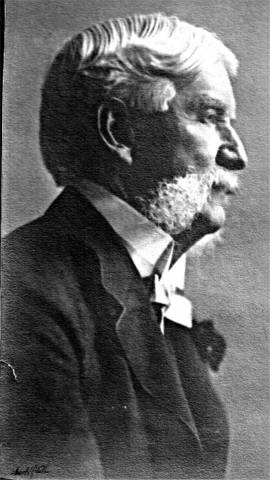
H.M. Yerington was an important man in Nevada as was his son, James A. Yerington. This native son was active in mining and politics at the state level. He was the Nevada Executive Commissioner at the World's Fair and gave the community a souvenir book showing "... a haying scene in Mason Valley, the only agricultural picture. Mason Valley, we presume, was considered the garden spot of the Nevada." We would go on to national politics being present at Theodore Roosevelt's inauguration.
These men were celebrities of the late 19th century and their movements were tracked by- local newspapers. As ear1y as April 8, 1893 the editor of the Mason Valley Tidings, D. L. Sayre, wrote "D.O. Mills and H.M. Yerington passed Wabuska southward bound Wednesday on a tour of inspection of the railroad. Tidings wishes they might visit this valley." On August 19, 1893 he wrote "H.M. Yerington is at present making a tour of inspection of the C Railroad. We hope Mr. Yerington will visit this valley, that he may meet our solid citizen and discuss the feasibility of extending the railroad into the valley..." January 4, 1894, "If, as many people believe, the C & C Railroad is built into Mason Valley this year - it only skirts the eastern border now - '94 will see our population and taxable property double."