Showing posts with label 1908. Show all posts

Monday, May 23, 2016

Yerington Monday: Frank Bugbee’s Granite Times
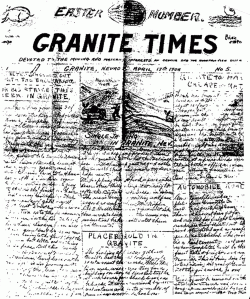
Frank Bugbee’s Granite Times


Homemade, handwritten newspapers were a noble tradition in Nevada’s pioneer days, but the best may have been the last: Frank Bugbee’s Granite Times.

Granite was a mining camp and post office from May 1908 to May 15, 1909.  It was seven miles west of Schurz.  Granite was founded when mineral locations were made in the area in March 1908.  Shortly thereafter, the Mountain View Mining District was established attracting 200-300 speculators, saloonkeepers, prostitutes and drifters of every stripe.  Among them was Frank Bugbee.


A native of Ohio, Bugbee had taught school in Kansas before arriving in Nevada around the turn of the century.  He turned up in a number of mining camps before joining the rush to Granite and starting the Times.  Bugbee’s enterprise did not survive beyond seven issues, judging by surviving copies, but it was a lively journal whit it lasted, providing insight into the life of the obscure camp and the outlook of an ingenious editor.


         

The Easter edition of April 17, 1908 featured drawings of a colored egg, a chick, a rabbit and a scene  entitled “Single Jacking in Granite.”  The issue reported that a Mr. Burroughs had struck placer gold while digging the foundation for a building and that Raleigh Baker had recently returned from Yerington with a new pair of shoes --both for the left foot.

A new well was being dug just north of town,  There was progress on the auto road to Schurz, and the Schurz String Band had played at Granite’s “Second Ball.”


Bugbee’s readers learned that a local steam laundry operator had made a trip to Yerington to purchase a parrot, which he was teaching to say, “Hand and steam laundry.”  Ads appeared for Dry Hide Louie’s Shaving Parlor, the J.J. Lunch Room (“cement floors a specialty, and for a man named Butterfield, “Real Estate and Chickens.”


Bugbee even reported on himself.  He had ordered a carload of type to print his paper properly, but through an error he received a mess of tripe.”  Bugbee was equal to the situation, however.  He offered “a bar of soap and a pound of tripe” to those who solicited others for new subscriptions to the Times.

Bugbee liked to print aphorisms and pithy advice.

__”Don’t argue politics on the street, better try religion.”
__”Monotony and rust eat out ambition--we don’t blame people for being just a little wicked once in awhile just for a change.”
__ “Being a big husky man saves a great many from getting a good licking.”
__He remarked that young girls often wondered who their husbands would be, while those who had them wondered where they were.”


Bugbee pushed for culture in Granite.  He supported an effort to import a preacher, but he warned anyone considering the position not to come ”unless he is a good hammerman and can handle a shovel.”

The Easter issue included a poem by  local miner, M. L. Ruef, who occasionally helped out at the Times office:

“ Granite, Granite, Granite,
You are the wonder of the day.
And you’ll always be remembered
In a good old -fashioned way.
A town of jolly fellows
And pretty girls a few,
Granite you are a wonder
We take our hats off to you.”
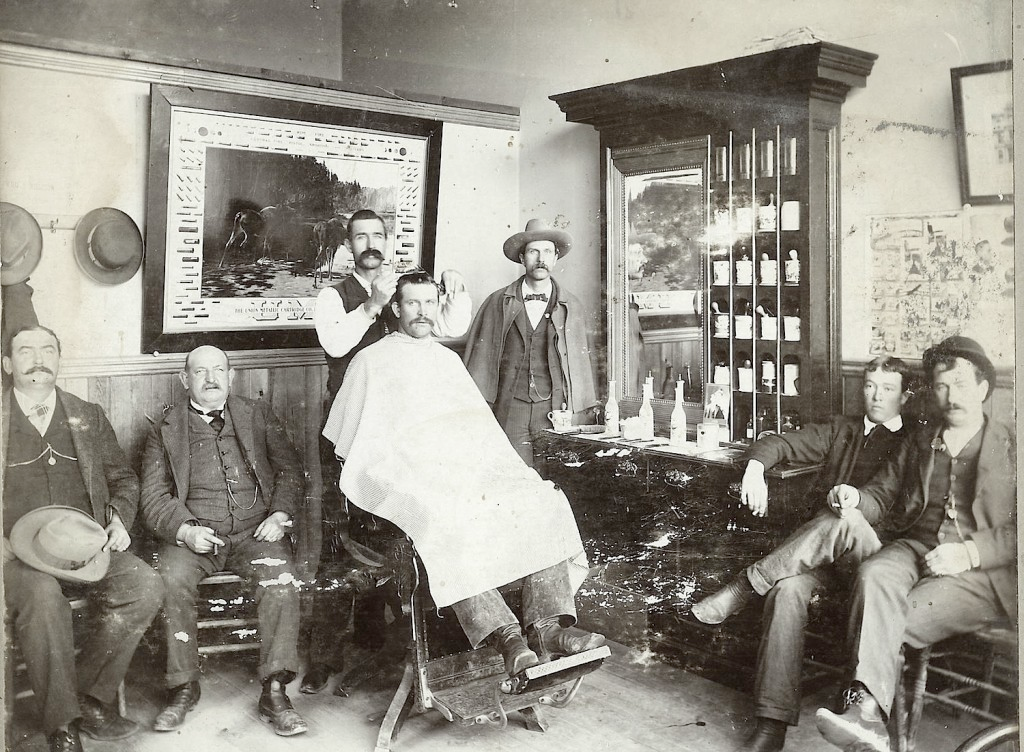

In the May 1 issue, Bugbee reported that Dry Hide Louie had amassed so much wealth from panning miner’s whiskers that he had retired and moved to Yerington.  There was a plug for the town’s physician, Mrs. Dr. Carpenter.  Bugbee recommended that his readers go to her for sulfur and molasses, since spring had arrived.  His own mother had given the remedy  to him, he wrote, and he could still taste it 20 years later.

The May 1 issue is the last surviving for the Granite Time.  In it Bugbee summed up his philosophy:  “Stop grumbling.  Get up two hours earlier in the morning and do something out of your regular profession.  Mind your own business and with all your might let other people alone.  Live within your means.  Give away or sell your dog.  Go to bed early.  Talk less of your own peculiar gifts and virtues and more of those of your friends and neighbors.  Pay your debts.  Be yourself all you would see in others.  Be a good man and stop grumbling.

As a mining camp, Granite never got beyond the leasing stage, and when its fortunes waned, its inhabitants began to depart for newer, richer diggings.  Among those who took their leave was Bugbee.  Moving on to Dayton, where he acquired some mining properties, he later became a Lyon County deputy sheriff and served in the Nevada Assembly in 1931, 1933, and 1935.  In the early 1940’s, he moved to Yerington.  He died there on April 4, 1943, just after his 73rd birthday.
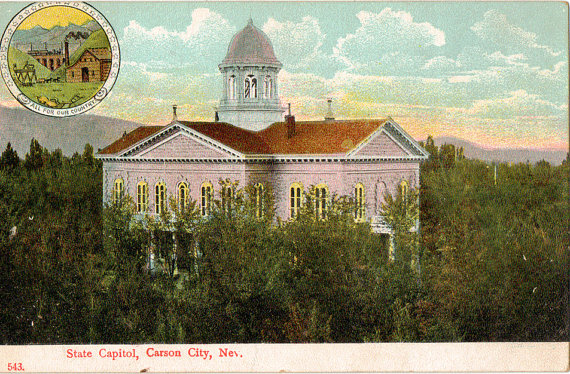

The two surviving issues of the Granite Times, kept at the Nevada Historical Society, were donated by Bugbee himself in 1909.  They can be viewed on microfilm or in their original full-color glory at the museum and research library in Reno.

These two issues seem to belie, but do not disprove, the spirit of optimism that brightened his editorials:  “Take courage, my brothers, take courage,”  he wrote.  “Do not get discouraged because you have not the tools and equipment you should have to run your lease.  The editor has only three lead pencils, but he gets out a paper every week.”


(Nevada Magazine, June 1982 “Type, Tripe and the Granite Times” by Phillip I Earl and Eric N. Moody)
~~~~~~~~~~~~~~~~~~~~~~~~~~~~~~~~~~~~~~~~~~~~~~~~~~~~~~~

Reno Evening Gazette - April 5, 1943
MR. FRANCIS E. BUGBEE
Frank Bugbee Dies In Lyon County
---------------
Illness Fatal To Mining Man
---------------
YERINGTON, April 5. -- Francis (Frank) Eugene Bugbee, long-time Nevada resident, mining man and legislator, died at the hospital here Sunday night after an illness of several months.

Born in Ohio seventy-five years ago, he grew up in Kansas and Colorado and came to Nevada during his youth, locating in Mason valley and Dayton where he followed mining for many years. He served as a deputy sheriff at Dayton for a time and was an assemblyman in the Nevada legislature during the sessions of 1931, 1933 and 1937. In the legislative session which closed just a few weeks ago, he served as assistant sergeant-at-arms although he was ill at the time.

In addition to his widow, the former Mabel Lord, whom he married in 1927, Mr. Bugbee is survived by a son, Lyle, a government employee in Texas; a sister, Jesse Callahan of Abilene, Kas.; a brother, William Munden of Abilene and an uncle, Charles Osborn, of Winnemucca. Funeral services will be announced later.

Sunday, January 24, 2016

Yerington Monday: The Mines of Lyon County: Ludwig Mine

Yerington Monday: The Mines of Lyon County: Ludwig Mine

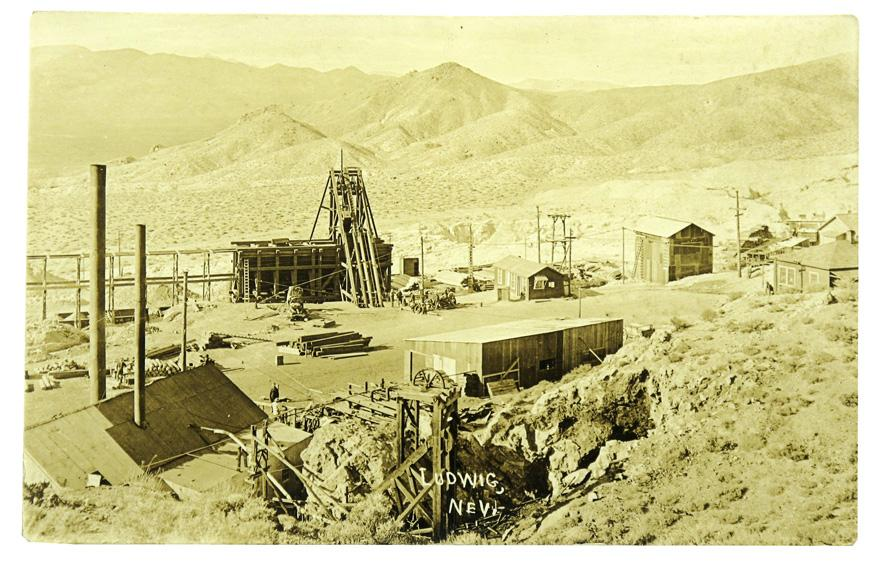
Ludwig was established in 1908 by the Nevada-Douglas Company to mine and smelt the copper ore for shipment to Carson City for further processing. It remained active until 1914 when production began to decline. The open scars, pits, and holes remain today, but mining has all but stopped throughout the area.


Photo of the Nevada-Douglas Mine from the book " LYON COUNTY- WHERE IT IS, AND WHAT IT CONTAINS: Close to California, made up of rich valleys and mineral-laden hills, it still has available lands at reasonable prices, and is an ideal homing spot." by CORA FAY WHITE, 1913


John D. Ludwig, Indian fighter from Northern CA in 1860-70's who also discovered copper in Ludwig (Esmeralda County, Later Lyon Co.) in 1870's in northern Smith Valley, NV. Small town named for Ludwig as the was the mine. He sold his mine which later turned out to be one of the largest in the U.S. and there was a train built to it (the Copper Belt Railroad). Ludwig was quite an eloquent speaker at the Silver Party political conventions, was deaf in one ear with age, was in Japan in 1903 (why?), sold mine, went to CA. The history in NV is scanty on him because someone in the county mixed the names of John D. (copper miner) with another John T Ludwig (different man in Mason Valley) and the two biographies have been scrambled.

The Ludwig Mine, in Mason Valley, has produced tons upon tons of copper, and it has not been fairly prospected yet.- Reno Evening Gazette, January 10, 1888


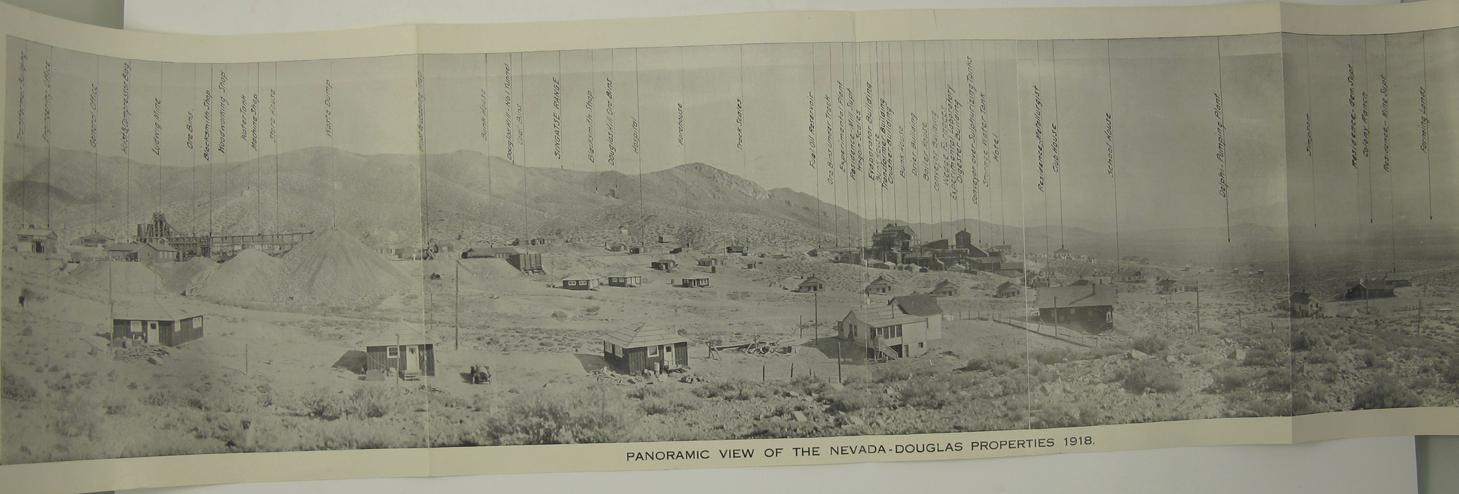
A panoramic photograph showing the buildings at the Ludwig mine site and even alkali flats and ranches in the distance. The photograph was issued compliments of A.J. Orem & Co. of Boston, MA. Orem was the president of the Nevada Douglas Consolidated Copper Co., which was a 1915 reorganization of the old Nevada Douglas Copper Co. The reorganization included the Ludwig Mine. In addition to the copper ore, the Ludwig had a very large deposit of gypsum. The mine was located about a mile northwest of the Douglas and included 2 claims on a 40-acre tract in Smith Valley.


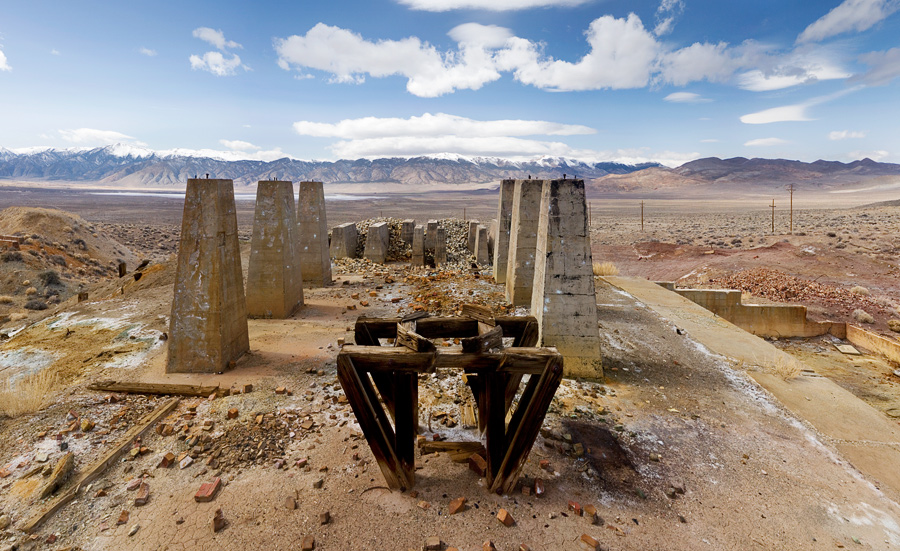
What remains at Ludwig is the remnants of the smelters and their supporting structures – foundations and various concrete superstructures.


Ludwig Mine Area - West of Yerington, NV

In this area of the state, copper was extensively mined, and Ludwig is no exception. Copper ore was discovered in the mid 1860's and produced for a couple of years, but they didn't have much luck smelting it until after the turn of the century when the Nevada-Douglas Company bought the mines in 1907. Almost a thousand people lived and worked at Ludwig until 1914, when activity waned. They began mining gypsum in the 1940's but by 1960 most everything was gone.


Mine processing building - Ludwig


The train would go from Wabuska to Yerington and Mason, down to Nordyke and Wilson, then swing through Wilson Canyon and head north on the other side of the range to Hudson, Colony, and Ludwig.

In 1911 the camp began to be served by the Nevada Copper Belt Railroad from Wabuska.  The train would go from Wabuska to Yerington and Mason, down to Nordyke and Wilson, then swing through Wilson Canyon and head north on the other side of the range to Hudson, Colony, and Ludwig. By the way, if you'd like to see the Wabuska railroad station, it's at the Nevada State Railroad Museum in Carson City. The Nevada Copper Belt Railroad Company was completed in 1911 and was mainly used to haul freight from Ludwig, Nevada, where the headquarters of the Nevada-Douglas Consolidated Copper Company was located, to the smelter at Thompson which was on the main line of the track about 19 miles north of Nordyke.

The company was reorganized in 1941 as the Nevada Copper Belt Railway Company. In 1942, the 9 miles of track from Hudson to Ludwig as well as the 2 1/2 miles from Wabuska to Thompson were removed. The passenger service was terminated in 1945, and the entire line was abandoned in 1947.


6/12/1908 - 11/24/1911 (Morningstar) 11/24/1911 - 7/19/1932 (Ludwig)

The camp of Morningstar coalesced from the influx of men and equipment, and it was eventually named named Ludwig around 1911, although it was referred to as Morningstar after that occasionally.

MINING CAMP FIRE

Morningstar, the terminal town on the Nevada Copper Belt railroad, was visited by fire one morning this week. The property loss was heavy, but was covered by insurance. - Reno Evening Gazette, 12/16/1913


What is most unique about the site is that it appears some artists have decorated several pillars of one of the old buildings with extensive artwork. No one seems to know exactly who did the work or when it was done, but one website suggests that it was a group of art students. It doesn’t suggest from what school. Most of the art is still clear, but we noticed that a typical idiot with a gun, who seems to feel that it is necessary to shoot at signs, has visited the site – apparently those who cannot hit live game feel the need to shoot at signs and concrete walls that cannot move.


Ludwig decorated  pillars


Ludwig Mine Vent Shaft


Ludwig Nevada Ludwig Mine Vent Shaft 2

There are lots of open mines that can be very dangerous.  Please be careful when exploring these areas.


Man dies after falling down mine shaft

October 18, 2008
A California man died after he fell into a mine shaft near Smith Valley on Saturday morning, according to the Lyon County Sheriff's Office.
Terry Berardy of Mokelunke, Calif., was unconscious and unresponsive after he was extricated from the shaft in the area of Ludwig Mine.
Deputies and other emergency workers from Lyon County Search and Rescue, Mason Valley firefighters and the Washoe County Hasty Team assisted with the rescue and extraction.
He was pronounced dead at the scene after workers extricated him from the mine shaft. No one else was injured, according to deputies.
Berardy had fallen at least 80 feet down the shaft as he and other friends and relatives were exploring the area, which is located along the mountain range between Yerington and Smith Valley.  The investigation is continuing.


Ludwig Mine  Entrance


Ludwig Mine  Entrance


Ludwig Mine Trail

This trail begins in a residential area around the towns of Smith and Wellington and runs north through the historic mining area of Delphi and Ludwig. It crosses Mason Pass and the Singatse Range and ends near the town of Yerington. After navigating the paved roads of the Main Ranch Residential area, the trail truly begins on the sandy and dusty, dirt Delphi Road. Very little vegetation other than sagebrush adorns the landscape surrounding this two-lane, flat easygoing road. Special Attractions: Historic Ludwig ghost town with numerous remains to explore. Easy trail within a network of 4WD tracks to old mines.

There's definitely cool things to look at. Fun drive. At the actual site of the mine some of the smaller trails are a little scary in a full size vehicle but not too bad. I made it just fine in a modified 2WD high-clearance F150. Word of caution: several people have died in the mine shafts. Not only are there steep falls some of them are filled with toxic gas. Heed the warnings and fences around the mines.


EFFECT OF THE STORM

The smokestack at the Ludwig mine was blown down and totally demolished during the late windstorm. Several small buildings were also demolished. - Reno Evening Gazette, 2/15/1904


A CLOSE ENCOUNTER in a GHOST TOWN

Herb in Ludwig, Nevada...1942

One morning I took off from Reno to explore an old ghost town called Ludwig, near Yerington. While hunting through an old station, I heard a car motor wheezing over the rough steep hill, and hitching my gun forward, I scanned the hillside for sign of the car. It proved to be an old Model T Ford and two men were in it. One, a man of about 50, was dressed shabbily, while the younger man was more neatly attired. We spoke for about 15 minutes and found that the more elderly of the two was the caretaker of the abandoned mines and he asked my business. Somehow I felt uneasy in his presence and I was glad I packed my gun. While we talked, the younger man edged to my other side as if looking me over. I presumed he could see my holster against my thigh.  Later I learned that the older man had shot and killed a man who was hunting through the old buildings without having gained permission. The local authorities asked a few questions but he never was held for the killing…HR, 1942.


From the 1913-ish book, LYON COUNTY- WHERE IT IS, AND WHAT IT CONTAINS: Close to California, made up of rich valleys and mineral-laden hills, it still has available lands at reasonable prices, and is an ideal homing spot. by Cora Fay White:

Ludwig is essentially a mining camp thrifty, prosperous and cosmopolitan! The Nevada-Douglas Mining Co. has extensive works there, and these, together with The Gypsum Plant, afford employment for many men. Comfortable residences, adequate offices, modern school house, social hall, and a variety of commercial houses are to be found in this typical Nevada camp, which, after all, does not differ in personnel from any other cosmopolitan community, either East or West. Electricity is used practically in the mines, as well as for all other possible purposes.

Almost a thousand people lived and worked at Ludwig until 1914, when activity waned. They began mining gypsum in the 1940's but by 1960 most everything was gone.


Here are a few more panos of an old mining mill site, Ludwig, in Smith Valley, Nevada. I don't know very much of the history of the mill and mines. There was once a railroad that went from this location to Yerington and Wabuska, to the east and the north. The only thing left of the railroad are traces of the grade.


There are more ruins and debris in Ludwig than our initial studies led us to believe. It's a large site with lots of interesting things scattered over quite a large area. There were several of what we'll refer to as "mills" in the area. We're pretty sure they were used to reduce the copper ore for shipment elsewhere, and/or possibly for use with the gypsum operations that came later. The copper mines in the area were large, open, and scary. Clearly, copper deposits are larger than gold and silver and the massive amounts of rock that has to be moved to get at it was evident here. Huge tailings piles, huge mines and pits.


Large buildings of concrete and brick existed here. One of the concrete buildings was finished quite nicely at one time


Ludwig mine site


One of the interesting things was there seemed to be an unusual number of clay pipes in the area, some of which led to sumps and underground chambers. Was it a sewer system, or did it have to do with the copper or gypsum operations? Right now it's a mystery.


Gypsum mining starts up on Ludwig site

UPDATE 2-22-2014 Lots of fences going up, and men in pickups wearing safety vests indicate a renewed interest in the Ludwig area. No gates or signs yet, so if you want to see it now might be better then later.

UPDATE 1-16-2015 The Record Courier reports that Art Wilson Mining has begun work at Ludwig, fencing off 300 acres. They are getting quite cross about people cutting the fences, and will probably station someone out there to beat the crap out of you if you try. If you're lucky.

A popular off road four-wheeling destination has been fenced off after active mining operations began west of Yerington.
Art Wilson Mining has begun work at Ludwig, which was home to the Morning Star Mine and has fenced off 300 acres.
Safety Director Jesi McKee said the Carson City mining company has had considerable difficulty with people cutting their gates and fences.
“It’s completely closed to the public,” she said. “We’ve started to move material in preparation to start mining. It’s now considered an active mine.
The company plans to begin mining gypsum at the site very soon, she said.
“It’s amazing how many people drive through gates and fences, or cut their way in,” she said. “We’ve had many problems with trespassers out there.”
Ludwig is located on the west slope of the Singatse Range between Mason Valley and the northern tip of Smith Valley.
A big copper strike occurred there in 1907 at the Morning Star Mine, and the town of Ludwig was created in 1908 to house miners.
The town was once home to 1,000 people.
The mines were served by the Nevada Copper Belt Railroad from Wabuska starting in 1911. According to the Nevada Appeal, the train tracks were taken up in 1942.
Gypsum mining first started at the site in the 1940's.
The site features several concrete mill structures, many of which were painted with Egyptian symbols since the mines closed.
McKee said the site is not safe for members of the public, and that people should avoid mines whether they are active or closed.
Gypsum is used in the manufacture of drywall.

Friday, January 8, 2016

Yerington Monday: The Great Yerington Sack Race Part I

Yerington Monday: The Great Yerington Sack Race Part I
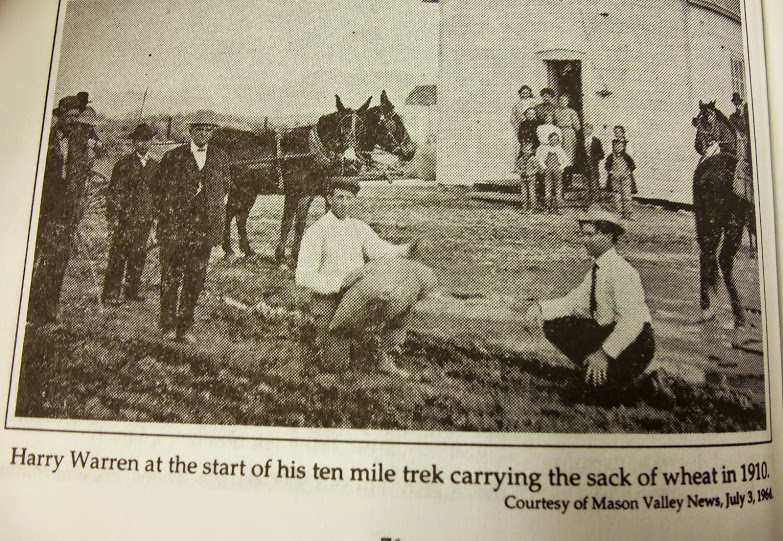
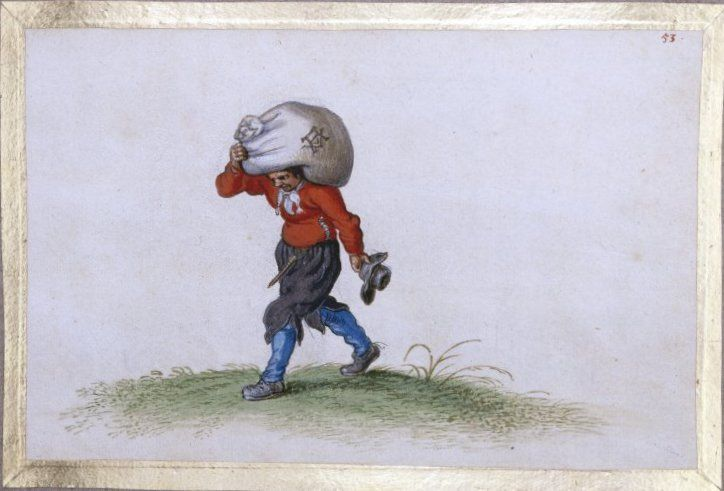
Yerington intermittently hosts what must be the most grueling single competition staged anywhere in the west. It doesn't appear in the list of annual events because it isn't held every year -- contestants can't be found that often. It's the World Championship Sack Race, and it dates back more than 80 years when a young farm hand named Harry Warren made local history.

Harry was working as a ranch hand near Wabuska. He and some other men were loading a wagon with 120-lb. grain sacks, and in the process they got to talking about how far a man could carry one of the sacks without having to put it down and rest. Harry made the outrageous claim that he could carry one all the way to Yerington, about ten miles away.
When his fellow workers challenged his wild statement, Harry said, "Oh, I can do it all right. But you'll have to make it worth my while."
So some of the biggest and strongest men in the valley experimented with carrying the heavy sacks, and none of them made it more than a quarter mile. Harry's challenge spread around the valleys, and a fund of $1,500 was accumulated to call Harry's bluff.
On the day of the great event Harry heaved the sack up onto his shoulders and started off rapidly toward Yerington at a rapid walk. To the utter astonishment of every witness, Harry made the ten miles to Yerington in about two hours, stopping to rest only once, and never slowing his relentless pace. One of the amazed backers of the bet was a local beekeeper. "The bees never stung me," he said ruefully, "but Harry Warren sure did.”

Sack Race, Main Street, Yerington, July 4,1908


Sack Race Ranch, 249 US Highway 95A N,
Yerington, NV 89447
(775) 463-0015


Sack Race Ranch sack race
Sack Race Ranch offering environmentally friendly alpacas. Alpaca fiber has been used for clothing since the days of Inca's.


Related Posts Plugin for WordPress, Blogger...