Yerington Monday: The Mines of Lyon County: Ludwig Mine
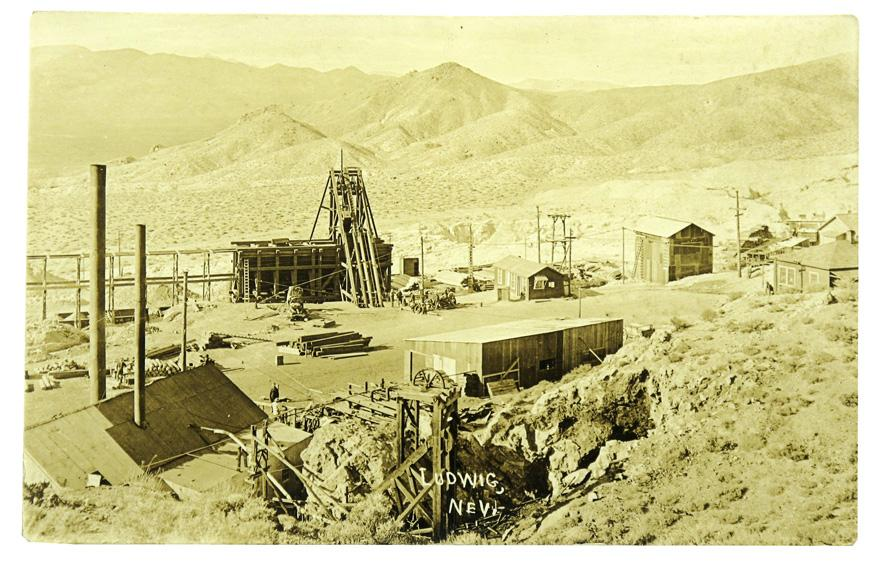
Ludwig was established in 1908 by the Nevada-Douglas Company to mine and smelt the copper ore for shipment to Carson City for further processing. It remained active until 1914 when production began to decline. The open scars, pits, and holes remain today, but mining has all but stopped throughout the area.

Photo of the Nevada-Douglas Mine from the book " LYON COUNTY- WHERE IT IS, AND WHAT IT CONTAINS: Close to California, made up of rich valleys and mineral-laden hills, it still has available lands at reasonable prices, and is an ideal homing spot." by CORA FAY WHITE, 1913
John D. Ludwig, Indian fighter from Northern CA in 1860-70's who also discovered copper in Ludwig (Esmeralda County, Later Lyon Co.) in 1870's in northern Smith Valley, NV. Small town named for Ludwig as the was the mine. He sold his mine which later turned out to be one of the largest in the U.S. and there was a train built to it (the Copper Belt Railroad). Ludwig was quite an eloquent speaker at the Silver Party political conventions, was deaf in one ear with age, was in Japan in 1903 (why?), sold mine, went to CA. The history in NV is scanty on him because someone in the county mixed the names of John D. (copper miner) with another John T Ludwig (different man in Mason Valley) and the two biographies have been scrambled.
The Ludwig Mine, in Mason Valley, has produced tons upon tons of copper, and it has not been fairly prospected yet.- Reno Evening Gazette, January 10, 1888
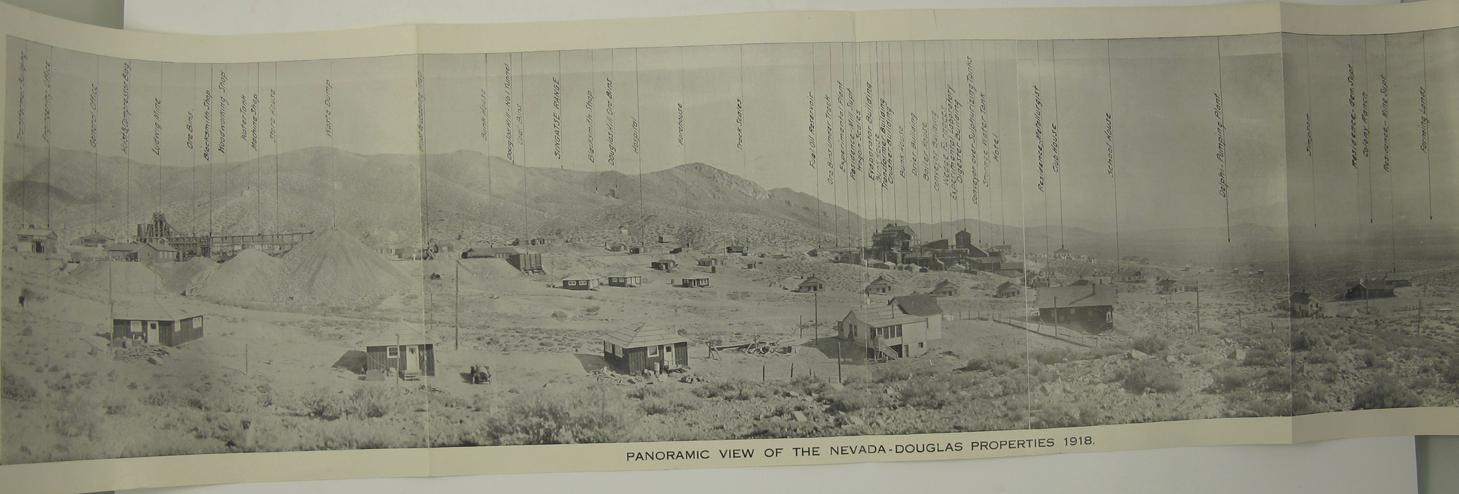
A panoramic photograph showing the buildings at the Ludwig mine site and even alkali flats and ranches in the distance. The photograph was issued compliments of A.J. Orem & Co. of Boston, MA. Orem was the president of the Nevada Douglas Consolidated Copper Co., which was a 1915 reorganization of the old Nevada Douglas Copper Co. The reorganization included the Ludwig Mine. In addition to the copper ore, the Ludwig had a very large deposit of gypsum. The mine was located about a mile northwest of the Douglas and included 2 claims on a 40-acre tract in Smith Valley.

What remains at Ludwig is the remnants of the smelters and their supporting structures – foundations and various concrete superstructures.

Ludwig Mine Area - West of Yerington, NV
In this area of the state, copper was extensively mined, and Ludwig is no exception. Copper ore was discovered in the mid 1860's and produced for a couple of years, but they didn't have much luck smelting it until after the turn of the century when the Nevada-Douglas Company bought the mines in 1907. Almost a thousand people lived and worked at Ludwig until 1914, when activity waned. They began mining gypsum in the 1940's but by 1960 most everything was gone.

Mine processing building - Ludwig

The train would go from Wabuska to Yerington and Mason, down to Nordyke and Wilson, then swing through Wilson Canyon and head north on the other side of the range to Hudson, Colony, and Ludwig.
In 1911 the camp began to be served by the Nevada Copper Belt Railroad from Wabuska. The train would go from Wabuska to Yerington and Mason, down to Nordyke and Wilson, then swing through Wilson Canyon and head north on the other side of the range to Hudson, Colony, and Ludwig. By the way, if you'd like to see the Wabuska railroad station, it's at the Nevada State Railroad Museum in Carson City. The Nevada Copper Belt Railroad Company was completed in 1911 and was mainly used to haul freight from Ludwig, Nevada, where the headquarters of the Nevada-Douglas Consolidated Copper Company was located, to the smelter at Thompson which was on the main line of the track about 19 miles north of Nordyke.
The company was reorganized in 1941 as the Nevada Copper Belt Railway Company. In 1942, the 9 miles of track from Hudson to Ludwig as well as the 2 1/2 miles from Wabuska to Thompson were removed. The passenger service was terminated in 1945, and the entire line was abandoned in 1947.

6/12/1908 - 11/24/1911 (Morningstar) 11/24/1911 - 7/19/1932 (Ludwig)
The camp of Morningstar coalesced from the influx of men and equipment, and it was eventually named named Ludwig around 1911, although it was referred to as Morningstar after that occasionally.
MINING CAMP FIRE
Morningstar, the terminal town on the Nevada Copper Belt railroad, was visited by fire one morning this week. The property loss was heavy, but was covered by insurance. - Reno Evening Gazette, 12/16/1913

What is most unique about the site is that it appears some artists have decorated several pillars of one of the old buildings with extensive artwork. No one seems to know exactly who did the work or when it was done, but one website suggests that it was a group of art students. It doesn’t suggest from what school. Most of the art is still clear, but we noticed that a typical idiot with a gun, who seems to feel that it is necessary to shoot at signs, has visited the site – apparently those who cannot hit live game feel the need to shoot at signs and concrete walls that cannot move.

Ludwig decorated pillars


Ludwig Mine Vent Shaft

Ludwig Nevada Ludwig Mine Vent Shaft 2
There are lots of open mines that can be very dangerous. Please be careful when exploring these areas.

Man dies after falling down mine shaft
October 18, 2008
A California man died after he fell into a mine shaft near Smith Valley on Saturday morning, according to the Lyon County Sheriff's Office.
Terry Berardy of Mokelunke, Calif., was unconscious and unresponsive after he was extricated from the shaft in the area of Ludwig Mine.
Deputies and other emergency workers from Lyon County Search and Rescue, Mason Valley firefighters and the Washoe County Hasty Team assisted with the rescue and extraction.
He was pronounced dead at the scene after workers extricated him from the mine shaft. No one else was injured, according to deputies.
Berardy had fallen at least 80 feet down the shaft as he and other friends and relatives were exploring the area, which is located along the mountain range between Yerington and Smith Valley. The investigation is continuing.

Ludwig Mine Entrance

Ludwig Mine Entrance

Ludwig Mine Trail
This trail begins in a residential area around the towns of Smith and Wellington and runs north through the historic mining area of Delphi and Ludwig. It crosses Mason Pass and the Singatse Range and ends near the town of Yerington. After navigating the paved roads of the Main Ranch Residential area, the trail truly begins on the sandy and dusty, dirt Delphi Road. Very little vegetation other than sagebrush adorns the landscape surrounding this two-lane, flat easygoing road. Special Attractions: Historic Ludwig ghost town with numerous remains to explore. Easy trail within a network of 4WD tracks to old mines.
There's definitely cool things to look at. Fun drive. At the actual site of the mine some of the smaller trails are a little scary in a full size vehicle but not too bad. I made it just fine in a modified 2WD high-clearance F150. Word of caution: several people have died in the mine shafts. Not only are there steep falls some of them are filled with toxic gas. Heed the warnings and fences around the mines.

EFFECT OF THE STORM
The smokestack at the Ludwig mine was blown down and totally demolished during the late windstorm. Several small buildings were also demolished. - Reno Evening Gazette, 2/15/1904

A CLOSE ENCOUNTER in a GHOST TOWN
Herb in Ludwig, Nevada...1942
One morning I took off from Reno to explore an old ghost town called Ludwig, near Yerington. While hunting through an old station, I heard a car motor wheezing over the rough steep hill, and hitching my gun forward, I scanned the hillside for sign of the car. It proved to be an old Model T Ford and two men were in it. One, a man of about 50, was dressed shabbily, while the younger man was more neatly attired. We spoke for about 15 minutes and found that the more elderly of the two was the caretaker of the abandoned mines and he asked my business. Somehow I felt uneasy in his presence and I was glad I packed my gun. While we talked, the younger man edged to my other side as if looking me over. I presumed he could see my holster against my thigh. Later I learned that the older man had shot and killed a man who was hunting through the old buildings without having gained permission. The local authorities asked a few questions but he never was held for the killing…HR, 1942.

From the 1913-ish book, LYON COUNTY- WHERE IT IS, AND WHAT IT CONTAINS: Close to California, made up of rich valleys and mineral-laden hills, it still has available lands at reasonable prices, and is an ideal homing spot. by Cora Fay White:
Ludwig is essentially a mining camp thrifty, prosperous and cosmopolitan! The Nevada-Douglas Mining Co. has extensive works there, and these, together with The Gypsum Plant, afford employment for many men. Comfortable residences, adequate offices, modern school house, social hall, and a variety of commercial houses are to be found in this typical Nevada camp, which, after all, does not differ in personnel from any other cosmopolitan community, either East or West. Electricity is used practically in the mines, as well as for all other possible purposes.
Almost a thousand people lived and worked at Ludwig until 1914, when activity waned. They began mining gypsum in the 1940's but by 1960 most everything was gone.

Here are a few more panos of an old mining mill site, Ludwig, in Smith Valley, Nevada. I don't know very much of the history of the mill and mines. There was once a railroad that went from this location to Yerington and Wabuska, to the east and the north. The only thing left of the railroad are traces of the grade.

There are more ruins and debris in Ludwig than our initial studies led us to believe. It's a large site with lots of interesting things scattered over quite a large area. There were several of what we'll refer to as "mills" in the area. We're pretty sure they were used to reduce the copper ore for shipment elsewhere, and/or possibly for use with the gypsum operations that came later. The copper mines in the area were large, open, and scary. Clearly, copper deposits are larger than gold and silver and the massive amounts of rock that has to be moved to get at it was evident here. Huge tailings piles, huge mines and pits.
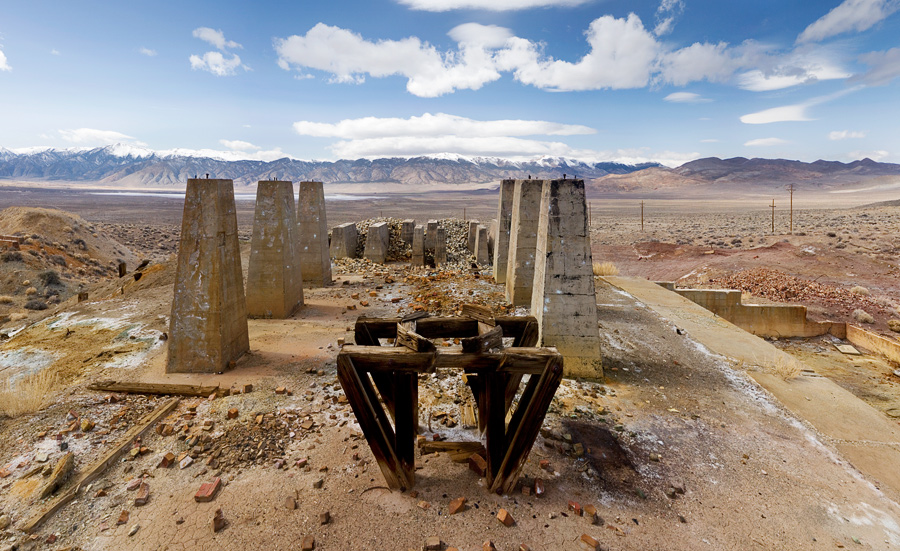
Large buildings of concrete and brick existed here. One of the concrete buildings was finished quite nicely at one time

Ludwig mine site

One of the interesting things was there seemed to be an unusual number of clay pipes in the area, some of which led to sumps and underground chambers. Was it a sewer system, or did it have to do with the copper or gypsum operations? Right now it's a mystery.


Gypsum mining starts up on Ludwig site
UPDATE 2-22-2014 Lots of fences going up, and men in pickups wearing safety vests indicate a renewed interest in the Ludwig area. No gates or signs yet, so if you want to see it now might be better then later.
UPDATE 1-16-2015 The Record Courier reports that Art Wilson Mining has begun work at Ludwig, fencing off 300 acres. They are getting quite cross about people cutting the fences, and will probably station someone out there to beat the crap out of you if you try. If you're lucky.
A popular off road four-wheeling destination has been fenced off after active mining operations began west of Yerington.
Art Wilson Mining has begun work at Ludwig, which was home to the Morning Star Mine and has fenced off 300 acres.
Safety Director Jesi McKee said the Carson City mining company has had considerable difficulty with people cutting their gates and fences.
“It’s completely closed to the public,” she said. “We’ve started to move material in preparation to start mining. It’s now considered an active mine.
The company plans to begin mining gypsum at the site very soon, she said.
“It’s amazing how many people drive through gates and fences, or cut their way in,” she said. “We’ve had many problems with trespassers out there.”
Ludwig is located on the west slope of the Singatse Range between Mason Valley and the northern tip of Smith Valley.
A big copper strike occurred there in 1907 at the Morning Star Mine, and the town of Ludwig was created in 1908 to house miners.
The town was once home to 1,000 people.
The mines were served by the Nevada Copper Belt Railroad from Wabuska starting in 1911. According to the Nevada Appeal, the train tracks were taken up in 1942.
Gypsum mining first started at the site in the 1940's.
The site features several concrete mill structures, many of which were painted with Egyptian symbols since the mines closed.
McKee said the site is not safe for members of the public, and that people should avoid mines whether they are active or closed.
Gypsum is used in the manufacture of drywall.